I ran a short Vaesen mystery for Old Joe, Sidney, and Sabriel: three investigators attached to the London house of the Society, near Highgate Cemetery. It was dark, tense, and rather more straightforward to prepare than I expected.
More usefully, it gave me a clear answer to one of the questions behind trying Vaesen: can its folklore-investigation structure carry a session without a large amount of plot written in advance?
For this session, I think the answer was yes.
Vaesen is a nineteenth-century folklore-horror game in which the investigators have the Sight: they can recognise the creatures and old powers that most people cannot see. As members of the Society, they are drawn into mysteries where industrial change, old obligations, and human interference disturb an already uneasy relationship between people and vaesen.
That premise gives a GM a useful starting point. A mystery can begin with an impossible event, then turn on what the group can learn about the creature and how it might be placated, outwitted, or stopped. The Vaesen Starter Set is a good introduction to that approach: it includes condensed rules, an introductory Society mystery, player characters, maps, handouts, reference cards, and custom dice.

Vaesen Starter Set contents. Image © 2025 Fria Ligan AB and Johan Egerkrans.
A hatbox for the Society
The mystery began with a delivery to the Society house. There was a plain hatbox, a red ribbon, and a small card marked only with a black star.
One of the house staff opened the box. For her trouble, she was drenched in blood. Inside was a skull, and nothing more.
I had based the moment on the Dullahan’s folklore: someone who opens a door as the headless rider passes can be drenched in blood. Moving that event into a hatbox made the danger immediate and personal, while leaving the players with questions rather than a fight.
The skull belonged to a Dullahan. In my version of the creature, the skull was also its vulnerability: someone who seized it could command the Dullahan, and destroying it would destroy the creature. The player characters did not know this. They only knew that an unknown organisation, the Black Star, had sent a dangerous object to the Society.
That distinction mattered. The Dullahan was not pursuing the investigators out of personal malice. It wanted its head back. The Society, and therefore the investigators, had become collateral damage in the Black Star’s plan.
Letting the clues create the plot
My preparation was deliberately small. I knew who had caused the problem, what the creature wanted, what would happen if nothing interrupted it, and the general atmosphere I wanted: dark, frightening, and increasingly urgent.
Everything else belonged to the table.
The players investigated through the strengths of their characters. They used contacts, History, conversation, and the Society’s resources to identify the skull and learn enough of the Dullahan’s nature to understand the danger. They found traits and possible countermeasures, but did not discover the secret of the skull before the creature arrived.
That did not feel like a failed investigation. It felt like the useful sort of partial knowledge that gives a group something difficult to decide. They knew enough to be afraid. They did not know enough to be comfortable.
This is where Vaesen worked well for me. A mystery does not need every clue to point towards one prescribed scene. I could present the situation, answer reasonable questions, and let the players make the connections. Their planning became the story.
A clock until sunset
I borrowed a progress-clock idea from Blades in the Dark to make the investigation’s deadline visible. The skull arrived in mid-afternoon, giving the players a safe period to research. Sunset was the point at which the Dullahan could begin to close in.
The clock did two jobs. For me as GM, it was a simple measure of when it was time to send the creature. For the players, it made the consequences of successful and unsuccessful research physical and visible. Each result did not only add information; it changed how much safety remained.
I liked that pressure because it did not tell the players what to do. It did not say that they had to fight the Dullahan, hand over the skull, or solve the Black Star’s larger scheme immediately. It simply made delay expensive.
That is a very useful tool for this kind of horror. The threat was not an abstract promise that something might happen later. It was coming after dark.
A quieter confrontation
Once the group understood that the creature was on its way, they chose not to meet it in the Society house. They lured it towards Highgate Cemetery, close enough to be practical but safer than waiting in the building, left the skull for it to reclaim, and observed rather than fought.
I liked that ending precisely because it was not a conventional final battle. The players had assessed a frightening creature, admitted what they did not know, and made a careful plan that protected the Society. The Dullahan got what it wanted. The investigators survived to follow the Black Star’s thread.
Old Joe, the former groundskeeper and gardener; Sidney, the street-urchin farm boy; and Sabriel, the country-house maid and huntress mystic, all contributed in ways that felt true to their characters. That is a good sign for a one-shot: nobody needed to wait for the obvious monster hunter to solve the case.
Dullahan, not Sleepy Hollow
It is tempting to call any headless rider the Headless Horseman from The Legend of Sleepy Hollow. The comparison is useful for atmosphere, but it is not the same figure.
The Dullahan is an Irish folkloric death-omen: a headless rider or coachman travelling at night, associated with the collecting of the doomed. Washington Irving’s Horseman is a specific literary ghost, a Hessian soldier said to have lost his head during the American Revolutionary War. Both belong to the wider family of headless-horseman stories, but I do not think it is accurate to say that one is simply the other in a different costume.
For this game, the Dullahan’s own folklore was more useful than the familiar American ghost-story image. The blood, the missing head, and the sense of an inevitable nocturnal visitor gave the mystery its tone before I needed to add much else.
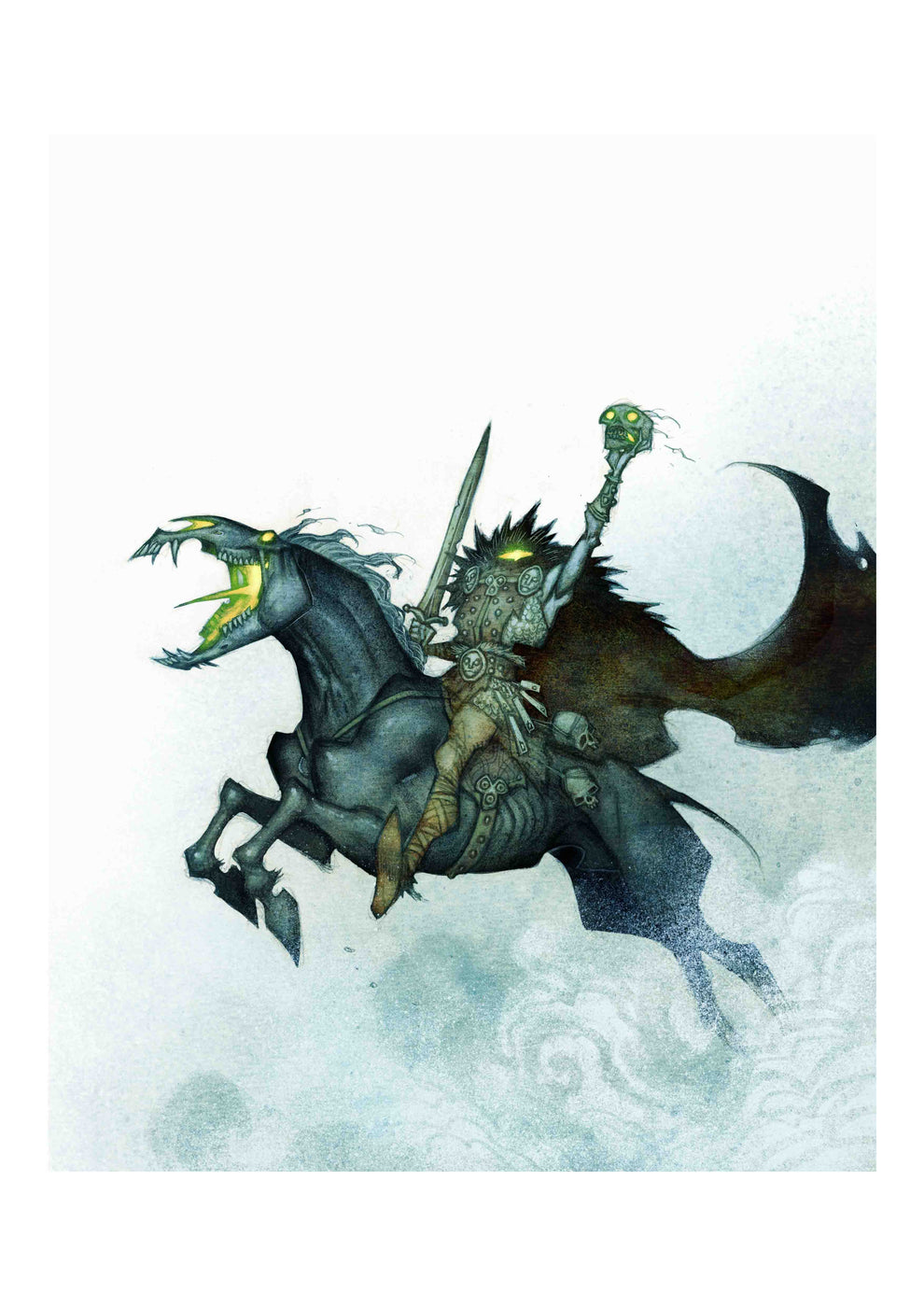
Dullahan by Johan Egerkrans.
What I learnt from the session
I would not treat one session as a complete review of Vaesen. We did not test every part of the game, and the players did not need to resolve the Black Star plot in a single evening.
But I do think it was a good demonstration of what the game is for. Vaesen gave me a way to make folklore the practical engine of the scenario. The investigators had to recognise a threat, ask the right questions, use their contacts, and decide what mattered before the night ran out.
For a GM, that is an inviting proposition. I needed a charged opening situation, a creature with clear needs, a small number of people behind the problem, and a deadline. The players supplied the investigation, intrigue, and strategy.
That is minimal preparation, but not empty preparation. It is enough material to let the table discover the session for itself.
Source material
For readers who want to explore the game’s setting and the folklore behind this session: