A good game handout should do two jobs at once. It should make me want to hand it to someone, because it looks like it belongs in the world, and it should let that person find the important bit when the game has gone off the rails. An interesting magic item is no use if the bearer cannot find its activation. A monster is not much help if its saving throw has disappeared into a page break.
The Homebrewery is built around that appeal. It turns text into pages which borrow the visual language of Dungeons & Dragons books: parchment, clear headings, sidebars, two columns and stat blocks. It is not a way to make an official D&D book, and that is not what I want from it. I want something that feels at home beside the books on the table while remaining clearly my own piece of homebrew.
I approached it as a GM and hobbyist rather than as a developer. That means looking at the whole route from an idea, through the editor, to a share link or printed page. I also had a useful starting point: an existing creature brew, Enchanted Bansai.
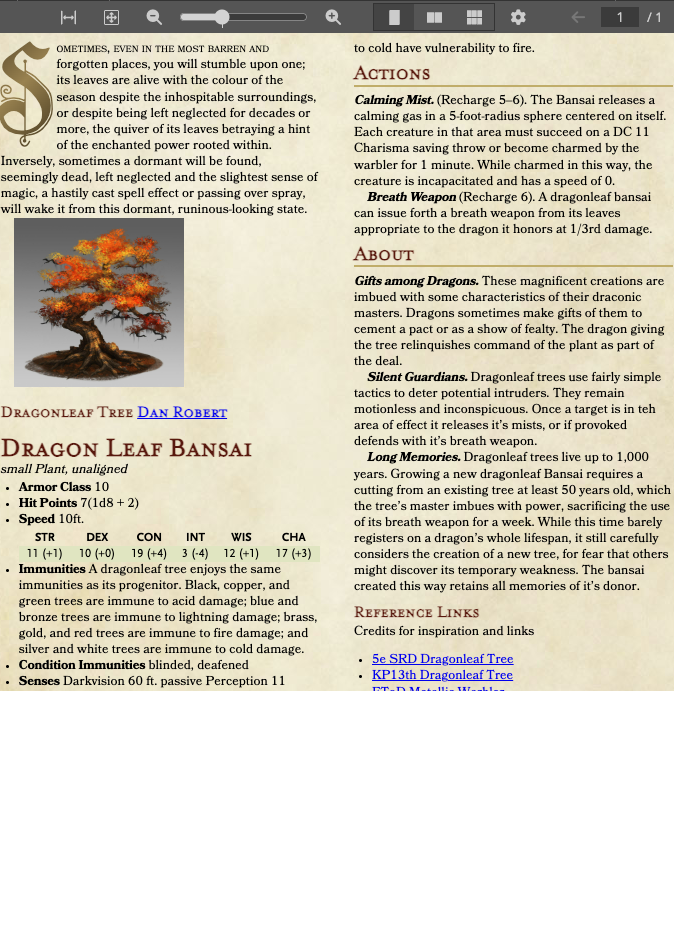
The rendered Enchanted Bansai brew. Illustration: Dragonleaf Tree by Dan Robert, as credited in the supplied brew.
The source is part of the tool
Homebrewery is not a word processor with a fantasy skin. An author writes Markdown, then adds the conventions that make a game page work: headings, emphasis, tables, quoted blocks, page and column breaks, and sometimes HTML or styling. That is not a hidden technical implementation detail. It is the authoring experience.
For the ordinary parts, I think this is a virtue. A heading is still a heading; an action still begins with bold text; a six-ability table is still plain enough to recognise in the source. It is much easier to revise a line of flavour text or an Armour Class in readable text than to drag little boxes around a canvas.
The other side is that the author becomes a small-scale typesetter. The current V3 guide recommends a Markdown-plus-curly-bracket syntax for much of the extra formatting, but raw HTML remains available when it is useful. That power is genuinely useful for an image or an unusual credit. It also means that a simple-looking flourish can require an image URL, an inline style, and a little thought about where the result will land on the page.
That is a reasonable bargain for me. I would rather learn a compact set of layout habits than learn a full desktop-publishing application for a one-page handout. I would not, however, start a session an hour before players arrive expecting that any pasted text will instantly look good.
Here is a shortened excerpt from the supplied Enchanted Bansai source. The image URL is omitted, but the Markdown and HTML are otherwise the same shape as the author sees:
## Dragon Leaf Bansai
*small Plant, unaligned*
___
- **Armor Class** 10
- **Hit Points** 7(1d8 + 2)

<img src="..."
  style="width:170px;float:center" />
A bonsai that shows both sides
Enchanted Bansai is a useful example because it already looks like the sort of thing I might put in front of a group: a short piece of strange fantasy, a credited illustration, a creature stat block, actions, background, and links to its inspiration. The public version makes the immediate case for Homebrewery. At a glance, it is a game artefact rather than a note in a folder.
Its source also makes the cost visible. The creature’s ability scores are a Markdown table. The image and its placement use HTML and inline styling. The attribution is part of the layout, not merely a line at the end. None of this is beyond a patient hobbyist, but none of it is free. When I change the art, the width, credit and balance of the first page may all need another look.
That is where Homebrewery rewards restraint. The stat block is easier to read because it follows a familiar pattern. The long descriptive sections need headings because the reader’s eye needs somewhere to rest. The image is more effective because it has a credit rather than pretending it appeared by magic. A handout can feel more polished than a plain document without becoming an exercise in decorating every empty corner.
The brew is also a reminder that handsome presentation does not replace an editing pass. A monster entry still needs consistent game terminology, a clear action with the necessary range, save and effect, and a final proofread. In this example, the references point to more than one source, so I would check every borrowed idea against the game and edition I intended to run before treating it as table-ready. Homebrewery makes a rule easier to present; it cannot establish that the rule is correct.
The Vault is part of the experience
The public Vault search is not just a community noticeboard. It is one of the first things a new author can use to answer, “What can this actually look like?”
I tried the supplied search for dragon without signing in. On 23 October
2026 it returned 879 published brews, with filters for V3 and legacy
renderers. Each result offered useful clues before opening it: title, author,
page count, update age, view count and public share or download links. That
is a surprisingly helpful way to find a one-page spell, a creature, or a
larger booklet and judge its shape before committing to a project.
It is also a messy library, which is no bad thing if approached with the right expectations. The results include old work, different conventions, and at least one entry where formatting markup has become its visible title. That is useful evidence of the tool’s flexibility and of its rough edges. The Vault can give a GM ideas about page structure, visual hierarchy and the range of material people make. It is not a rules index, an editorial seal of approval, or a catalogue of material that is automatically safe to reuse.
Only published brews are searchable there. That makes public discovery possible without an account, while preserving a useful boundary for work that is not ready to show. For a new author, I think the best use is to inspect a few different pages, notice what reads well, and then go back to make something with a clear purpose for their own table.
From browser to table
The live preview is encouraging, but I would not call a brew finished there. Homebrewery’s own printing guidance recommends Google Chrome for the most reliable PDF output. It also asks the author to match the document and printer paper sizes, offers an A4 snippet for those of us who need it, and recommends printing backgrounds when they matter.
This is the moment to be fussy. I would export the PDF, look at it at the size people will actually receive, and check the bottom of every column. A slightly different browser or machine can move a line far enough to push an important rule onto another column. Homebrewery asks authors to manage page and column breaks explicitly, so leaving a little breathing room is not wasted space. It is insurance against a stat block splitting at the wrong moment.
The same care applies to sharing. A share link is excellent for letting a group read a finished brew, but it is not my only copy. I would keep the plain source and the approved PDF somewhere I control. The service’s FAQ describes short-lived browser-held history, which is helpful when recovering from an accidental edit but not a substitute for my own archive.
Familiar is not official
The attraction of this style is obvious, but it creates a responsibility. The result should evoke a familiar D&D page, not pass itself off as an official product. I would use my own title, voice and material, credit art plainly, and avoid assuming that a public image or a public brew is mine to republish.
Homebrewery’s code is MIT-licensed, but that says nothing about the rights to the art, rules or setting material placed in a brew. For D&D rules content, the current System Reference Document explains what Wizards of the Coast makes available under Creative Commons and what requires a different route. That is worth checking before sharing work widely, especially if a handout has grown from a private game aid into something larger.
Would I use it?
Yes, with a modest brief. I would use Homebrewery for a monster, an item, a small player handout, or a short scenario that benefits from feeling like a thing found in the game world. It makes a blank page less intimidating and a finished page more inviting.
I would begin with the reader, not the decoration. What must a player find in ten seconds? What does the GM need to run this creature? What can be removed so the image, stat block and one memorable idea have room to breathe? Once those answers are clear, the Markdown and occasional HTML feel less like a barrier and more like useful craft.
For me, that is the real promise of Homebrewery. It lets a hobbyist make the scraps of an ongoing game feel worth keeping.
Sources and further reading
- The Homebrewery editor and V3 guide
- The Homebrewery FAQ
- Homebrewery Vault: dragon search
- Enchanted Bansai public brew
- D&D System Reference Document