After running a Dullahan mystery for our Society investigators, I wanted to see if I could turn the idea into something another Vaesen group could pick up and play. Not a retelling of the session, and not a rewrite of a published mystery: a compact, standalone scenario built from the situation that made our game work.
The first session began with a hatbox marked by a black star arriving at the Society house near Highgate Cemetery. A member of staff opened it and was drenched in blood. Inside was a skull. The investigators followed the clues, learned about the Dullahan, and worked out that the creature would come for its head after dark. They had found useful information, but not the head’s most important secret. Rather than wait for a fight at the house, they lured the Dullahan towards Highgate, left its head where it could reclaim it, and watched from safety.
That session left me with a good starting point for a scenario: an immediate threat with a clear desire, a deliberate act of intimidation by an unknown antagonist, and a time limit that made the investigators choose what to do with incomplete information.
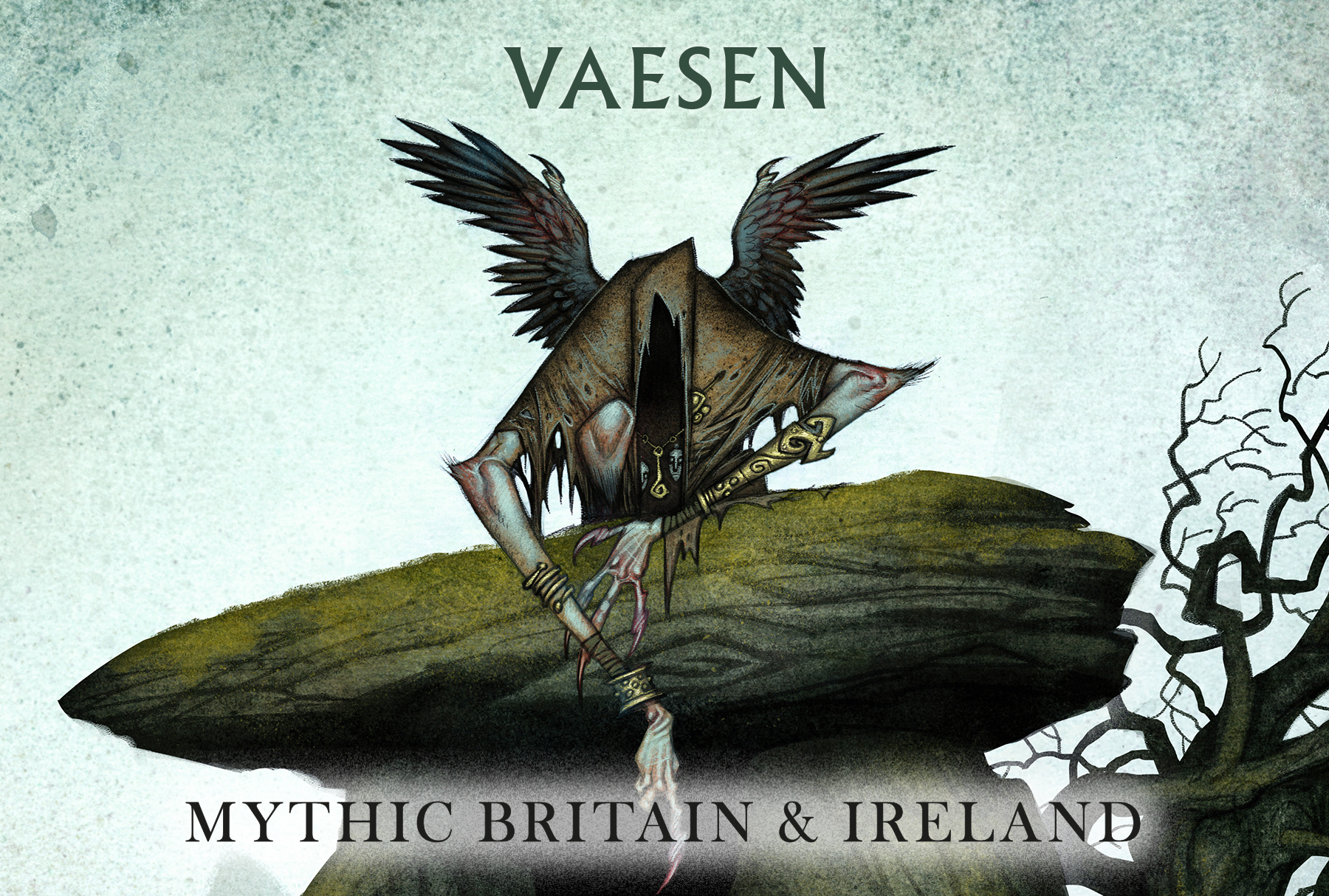
Banner artwork from the Free League Publishing press pack.
Researching the Dullahan
I returned to the Dullahan material in Vaesen: Mythic Britain & Ireland, particularly the creature entry on pages 60-61. The creature is more than a headless rider to be fought: it is a deathly presence with its own rules, behaviours, and vulnerabilities. The book’s aged, obfuscated text on page 61 also supplied the secret that drove the new scenario: the head can be seized to control the Dullahan, and destroying it destroys the creature.
That changed the shape of the problem. In our session, the investigators didn’t discover that secret before the Dullahan arrived, and they chose a cautious solution. For a standalone scenario, I wanted the group to have a chance to uncover the truth and decide what to do with it. Returning the head, using it to control the Dullahan, and destroying it should all feel like meaningful choices, rather than a single correct answer hidden behind a roll.
Learning from the published mysteries
I also reviewed the three mysteries in Mythic Britain & Ireland: Old Meg, The Llantywyll Incident, and The Hampstead Group. I used them as examples of how the book organises an adventure for a GM, not as text or plot material to reproduce. Each mystery has its own situation and play style, but their presentation offers a useful framework: establish the background and conflicts, give the investigators a reason to get involved, then support play with clues, people, places, escalating events, a confrontation, and possible aftermaths.
The differences between them were as instructive as the shared format. Old Meg builds pressure through danger to the community and conflict between locals and authorities. The Llantywyll Incident turns on a clash of beliefs, livelihoods, and supernatural neighbours, with more than one way to resolve the danger. The Hampstead Group layers a missing-person investigation with social barriers, misleading accounts, and a concealed predator.
Those examples helped me ask practical questions about the new scenario: What can investigators learn? What might delay or complicate them? What resources can they gather? What does the creature want? What changes if they return, seize, destroy, or lose the skull? The resulting scenario borrows the useful GM-facing organisation, but its plot and text are newly written around our Dullahan premise.
Turning the session into a one-page scenario
The biggest change was making the deadline explicit. The hatbox arrives without warning, so there is no ordinary Society preparation before the mystery starts. The investigators have a short daylight window to research and gather gold. Sunset marks the end of relative safety; the Dullahan may arrive at any point after dark, with midnight as the expected culmination rather than a precise appointment.
I wanted that clock to create urgency without taking choices away. The countdown advances when time is spent, the skull is exposed, or an investigation goes badly—not simply because the players ask questions. The Dullahan’s arrival is foreshadowed by signs from its description, so the threat grows in the fiction as well as on the clock.
The Society’s headquarters is the scenario’s only fixed location. Investigators may decide to find gold, consult a contact, hide the skull, or lure the Dullahan somewhere else. Leaving those places open gives the group room to make a plan instead of forcing a tour through a list of prepared scenes.
I kept the essential clues available through several routes: Society records, folklore knowledge, a specialist, or an NPC. A failed test can cost time or create a complication, but it should not stop the mystery. The secret of the head is what makes the final decision interesting, so it shouldn’t disappear because one roll went badly.
A press pack worth exploring
While researching and preparing the article, I also looked through Free League’s press page. I was struck by how useful the press material is for someone making something around the game: the supplied Mythic Britain & Ireland banner is large enough to work as a proper header, rather than a tiny logo or thumbnail. I used it both in the scenario PDF and here, linking back to the press pack and crediting the source. That kind of ready-to-use visual material makes it much easier to give a fan project a coherent look without having to invent artwork of my own.
The finished one-page scenario, The Head in the Hatbox, is available as a PDF. I have also kept its Markdown source alongside it in the site’s assets so it can be revised and republished later.
The earlier session write-up is here: A Dullahan, a Deadline, and a Night at Highgate.
This little project has been a satisfying loop: play a mystery, think about what made it work, research the folklore and the published adventure format, then make a new scenario that leaves the decisions to the next group.